

Article Key Takeaway
The recent market pullback has been driven largely by weakness in technology stocks, rising interest rates, and uncertainty around AI infrastructure investment. While short-term volatility can be unsettling, market declines are a normal part of investing. For long-term investors, maintaining a diversified portfolio aligned with their goals, time horizon, and risk tolerance can be more effective than reacting to short-term market swings.
Full Article
Market pullbacks can be unsettling, especially when headlines raise questions about what comes next. If the recent declines have you wondering what is driving markets or what they mean for your portfolio, those are understandable concerns. As your advisory team, our role is to help you separate short-term developments from the factors that matter most to your financial goals. The discussion below offers context for the recent volatility and a longer-term perspective—not a prediction of what markets will do next. We welcome the opportunity to discuss your questions and review how your investment strategy aligns with your time horizon, risk tolerance, and financial needs.
Here are the key facts to consider:
-
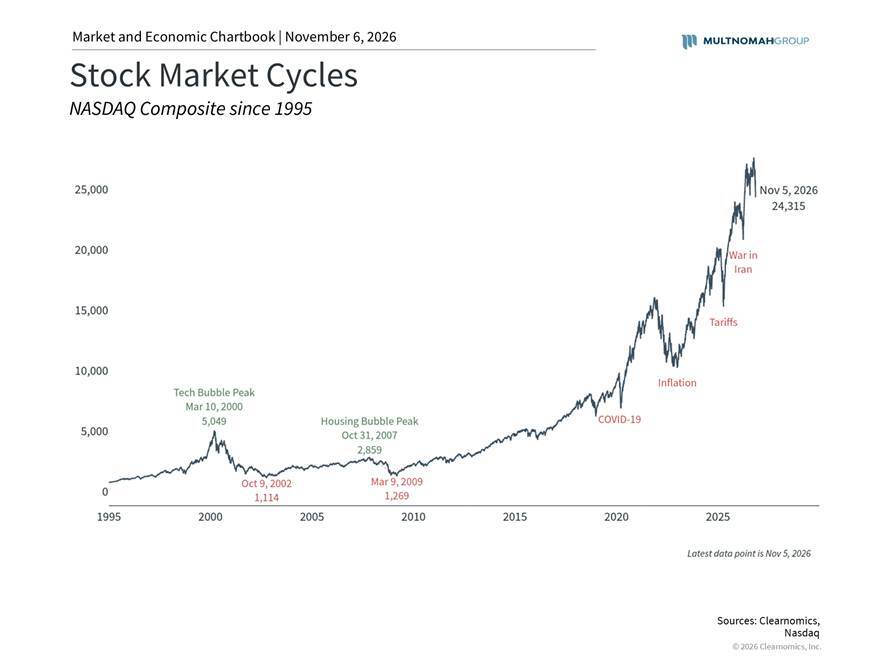
The Nasdaq Composite Index, which is concentrated in technology stocks, fell to correction territory recently after a decline of 12% from its all-time high, which was achieved just a month earlier. The decline on Thursday, November 5, two days after the midterm election, was the worst single-day decline for the more concentrated Nasdaq-100 since 2020. This was driven by semiconductor companies, chipmakers, and the so-called "neoclouds," which are new public companies that provide cloud computing services.
-
The key trigger of this short-term volatility was the midterm election result. This includes the shift to Democratic control of Congress, which is viewed as a challenge for ongoing data center construction. Voters in Texas, Ohio, Georgia, and other states backed new restrictions on new data center development. Thus, the midterm election raises questions about the pace of the AI infrastructure buildout of the past few years, which has supported economic activity and corporate profits.
-
Even before the midterm election, more defensive parts of the market had been supporting portfolios. Rising interest rates, with the 10-year Treasury yield around 5%, had put pressure on tech stocks because their valuations depend on future growth expectations. Concerns about billions in corporate AI investments, negative free cash flow, and competition from open source AI models raised further questions about these trends.
-
It's always important to maintain perspective when markets are volatile. These types of pullbacks, while never pleasant, are not unusual for highly sensitive parts of the market such as technology. In 2022, when interest rates rose rapidly, the Magnificent 7 group of technology stocks declined in value by nearly 50%. They then went on to recover and generate healthy returns for long-term investors. This is not to say that history will repeat itself exactly, but that market swings are a normal part of investing, and trying to time them can be counterproductive.
-
For long-term investors, these pullbacks do mean that valuations are more attractive. The irony is that while investors often wish they could invest at better prices, those opportunities occur during periods that are challenging from an investment psychology perspective. Balancing investment behavior with the right time horizon and asset allocation in order to benefit from attractive valuations can be a core driver of long-term investment success.
-
The reality is that the overall stock market has been surprisingly calm this year, despite short periods of uncertainty around the war in Iran, the Fed, and other events. The largest intra-year decline for the S&P 500, for instance, has only been about 9%, and there have only been two pullbacks of 5% or worse this year. This is atypical and has occurred because other sectors such as Health Care, Consumer Staples, and Materials have contributed to year-to-date returns.
The included chart showing market cycles for the Nasdaq Composite helps to put the latest pullback into perspective. Specifically, tech stocks can be volatile over short periods, but they have risen over longer timeframes. History shows that staying invested and maintaining a long-term perspective is still the best way to navigate periods of uncertainty.
Multnomah Group is a registered investment adviser registered with the Securities and Exchange Commission. Any information contained herein or on Multnomah Group’s website is provided for educational purposes only and does not intend to make an offer or solicitation for the sale or purchase of any specific securities, investments, or investment strategies. Investments involve risk and, unless otherwise stated, are not guaranteed. Multnomah Group does not provide legal or tax advice.