

The first quarter of 2026 underscores why preparation is so essential in financial planning and investing. Following strong gains in 2025, markets have contended with a combination of geopolitical disruptions, elevated oil prices, and renewed economic uncertainty. The conflict in Iran, which began in late February, emerged as the defining market narrative, driving oil prices sharply higher and triggering the year’s first meaningful pullback.
Stepping back for a broader view, markets have still delivered strong results over the past twelve months. Under the surface, several market segments — including energy and defensive sectors — have contributed meaningfully to portfolio performance. New questions are likely to emerge in the months ahead, among them a leadership transition at the Federal Reserve and the upcoming midterm election later this year.
For long-term investors, the first quarter serves as a timely reminder that markets rarely advance in a straight line, and that the principles of disciplined investing are most valuable precisely when uncertainty is highest.
Key Market and Economic Drivers
-
The S&P 500 experienced a total return of -4.3% in Q1, the Nasdaq -7.0%, and the Dow Jones Industrial Average -3.2%
-
The Bloomberg U.S. Aggregate Bond Index was flat for the first quarter of 2026. The 10-year Treasury yield ended the quarter at 4.3% after falling as low as 3.9% at the end of February.
-
Developed market international stocks (MSCI EAFE) were down -1.1% and emerging market stocks (MSCI EM) declined -0.1% over the quarter, both on a total return basis in U.S. dollar terms.
-
Oil prices spiked with Brent crude reaching $118 per barrel at the end of March after beginning the year under $61. WTI ended the quarter at $101 per barrel.
-
February inflation showed headline CPI rising 2.4% year-over-year and core CPI climbing 2.5%. The core PCE price index, the Fed’s preferred measure, rose 3.1% year-over-year in January.
-
The Federal Reserve kept rates unchanged within a range of 3.50% to 3.75% at both meetings during the first quarter.
Markets experienced the first pullback of the year
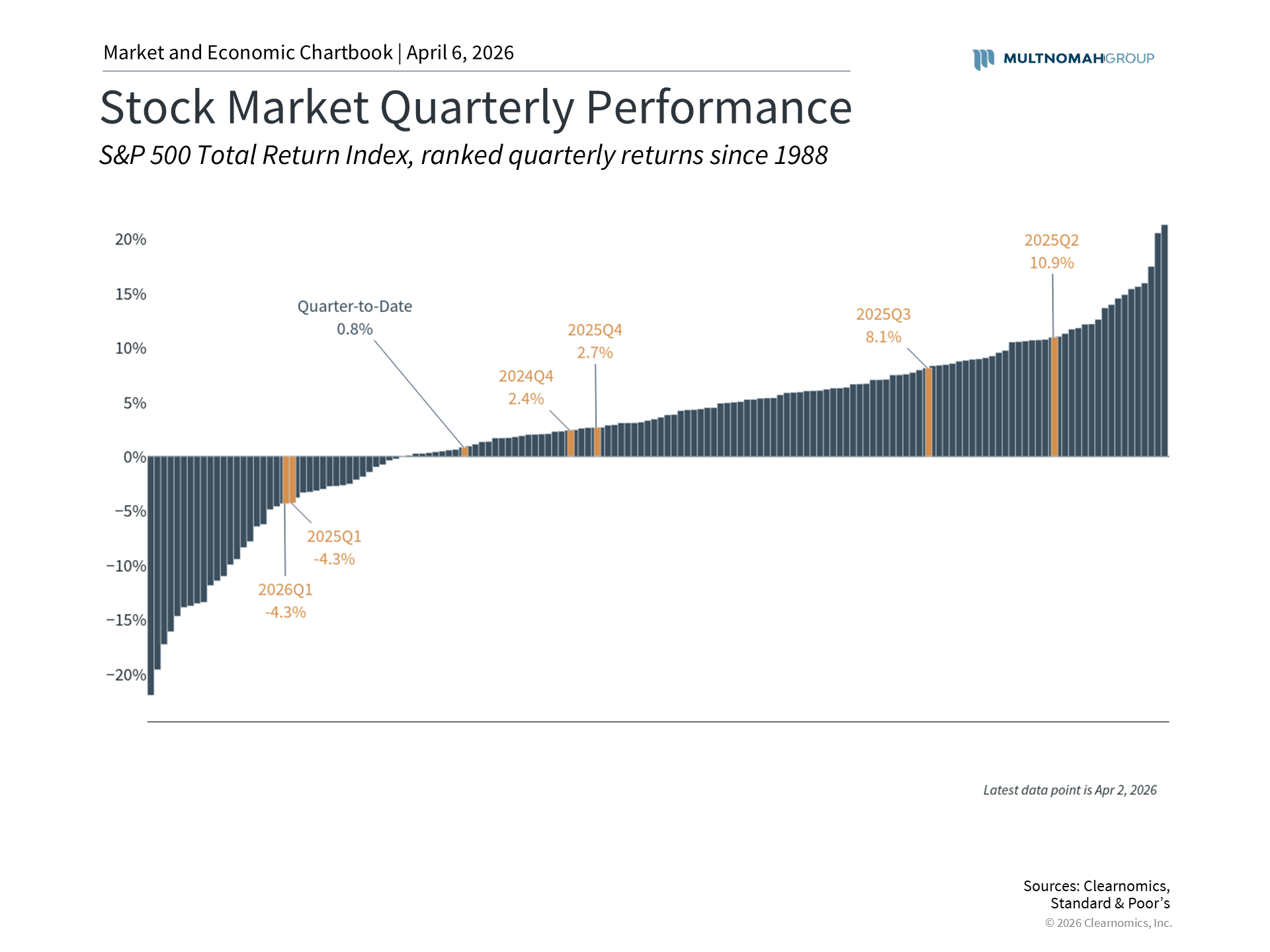
It is natural to draw comparisons between the opening months of this year and those of 2025, as both were shaped by global concerns. Notably, both first quarters saw the S&P 500 pull back by 4.3%. While last year’s turbulence was rooted in tariffs and this year’s stems from the conflict in the Middle East, the impact on investor sentiment has been comparable. When uncertainty rises, it is typical for markets to react in the short term to shifting headlines.
History is no guarantee of future outcomes, but taking a wider view can offer valuable context on how markets have tended to behave. Despite the challenges that defined Q1 2025, equity markets went on to post strong gains for the remainder of the year, including dozens of record highs across major indices. The point is not that markets always rebound quickly, but that market commentary tends to emphasize negative developments — meaning that when recoveries occur, they often arrive when investors least anticipate them.
Perhaps the most useful perspective is recognizing that pullbacks are a normal and unavoidable feature of investing. Since 1980, the S&P 500 has averaged an intra-year drawdown of approximately 15%, even though markets have delivered positive returns in more than two-thirds of calendar years. A typical year includes four or five pullbacks of five percent or more. Last year saw six such pullbacks, yet the S&P 500 still finished with an 18% total return.
For investors, the core lesson is that short-term market swings — particularly those driven by headline risk — are simply part of the market cycle. Portfolios structured around long-term financial goals are specifically designed to navigate these episodes. This perspective may be especially valuable as the midterm election approaches and fiscal concerns resurface later in the year.
Geopolitics and oil prices are the primary source of uncertainty
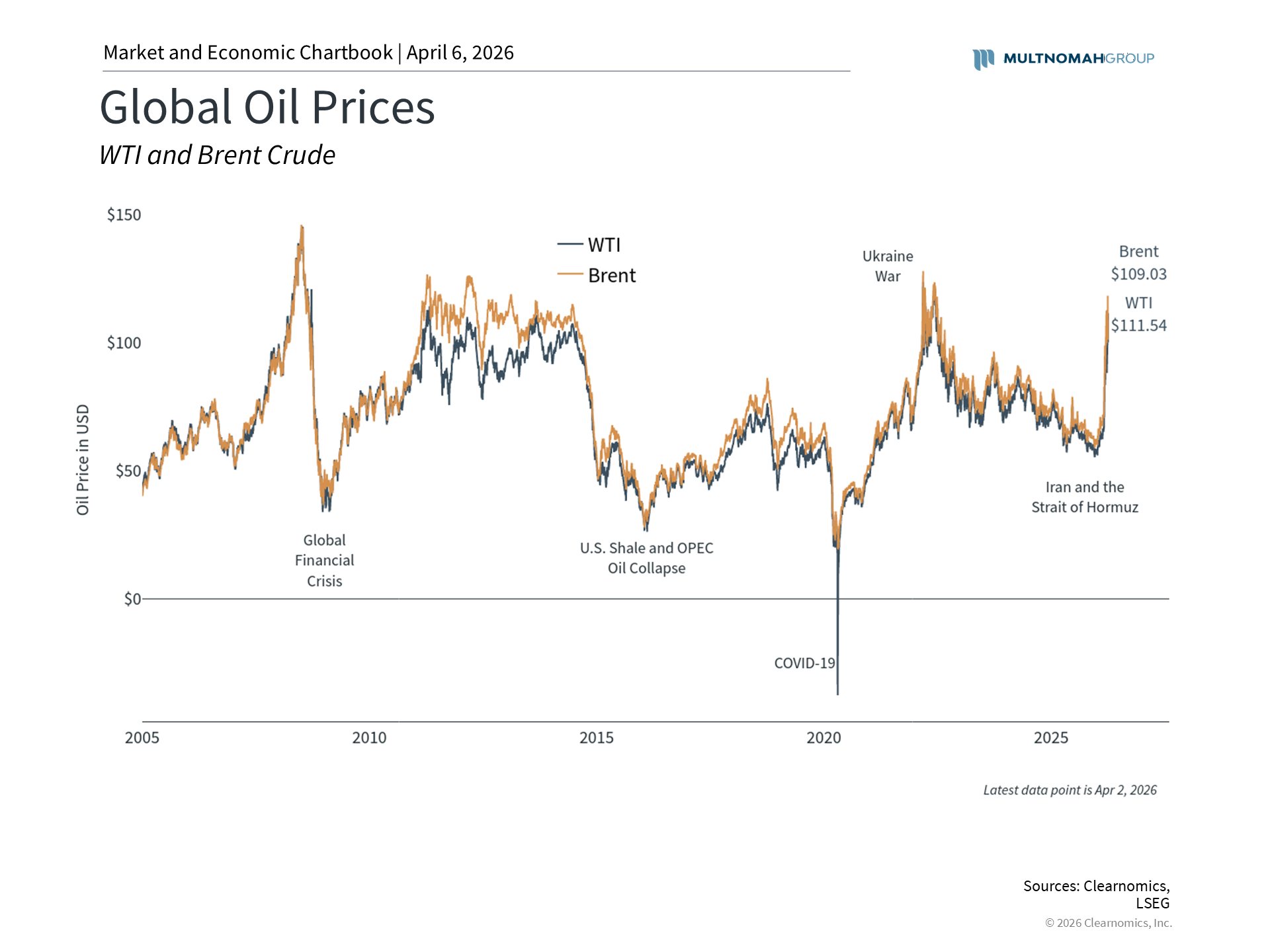
The most consequential market development of the first quarter was the escalating conflict in the Middle East, which sent oil prices surging. Disruptions to the Strait of Hormuz — through which roughly 20% of global oil flows from the Persian Gulf to the rest of the world — prompted production cuts among major oil-producing nations in the region. Brent crude closed the quarter at $118 per barrel, up more than 94% year-to-date, while WTI surpassed $100, reaching its highest level since the onset of the war in Ukraine in 2022. Oil prices will continue to respond to geopolitical developments, including any progress toward a potential ceasefire.
Higher fuel costs affect consumers directly through gasoline prices and indirectly by increasing the cost of goods and services throughout the broader economy. The national average price of gasoline reached $4 at the end of March, and diesel prices have also risen sharply.
While these developments do weigh on consumer finances, economists generally view such “supply-side shocks” as transitory when assessing overall economic health. This is because oil prices tend to stabilize once the underlying geopolitical event settles. This pattern played out in 2022 when gasoline prices climbed to $5 before retreating within months. While the current situation is uncomfortable, significant financial hardship is not anticipated for the average American household at prevailing gasoline price levels.
History also demonstrates that geopolitical events, while creating near-term instability, have not typically derailed markets over the long run. This includes the U.S. operation in Venezuela in January, which caught markets off guard but had little lasting impact on investments. While the current situation continues to evolve and the humanitarian consequences are significant, investors who made sweeping portfolio changes in response to past events often did so at an inopportune time.
Economic growth is slowing but remains positive
Volatile energy prices represent just one dimension of a broader economic picture. Other indicators point to an economy that has moderated over the past year but remains fundamentally sound — and this comes after many years in which widely predicted recessions failed to materialize.
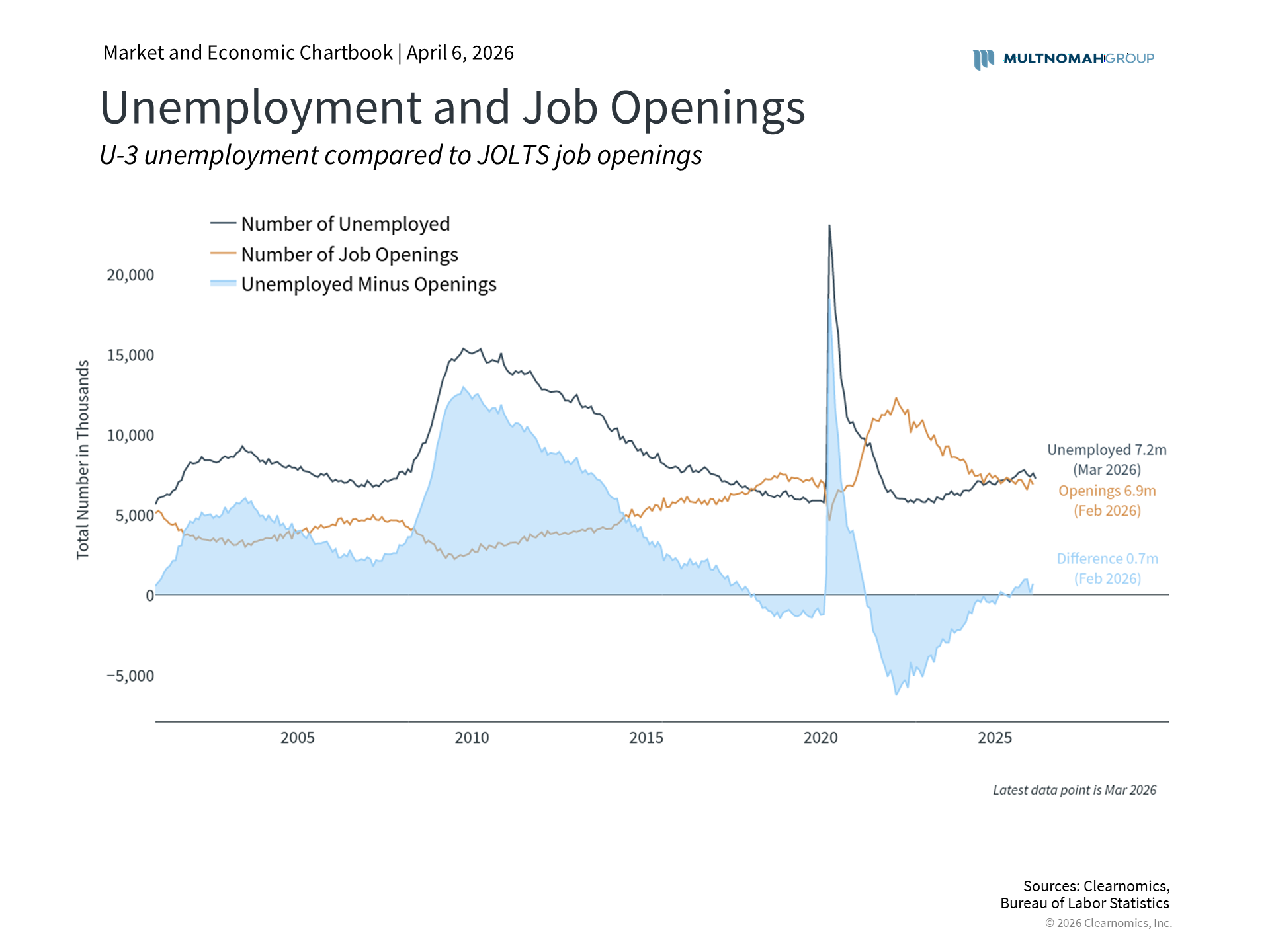
The labor market remains one of the most closely watched areas. The latest payrolls data show that February job gains declined by 92,000 and the unemployment rate ticked up to 4.4%. Notably, job seekers now outnumber job openings for the first time in years. As recently as 2022, there were two job openings for every unemployed person, reflecting an exceptionally tight labor market — a balance that has since shifted.
Context is important here. Fewer people are entering the labor force due to reduced immigration and an aging population. In other words, both supply and demand in the labor market are easing simultaneously, which has helped keep the unemployment rate near historically favorable levels. Investors pay close attention to employment data because jobs directly influence household income, consumer confidence, and spending. Consumer spending accounts for more than two-thirds of GDP and has remained stronger than many anticipated over the past several quarters.
Sector performance has diverged
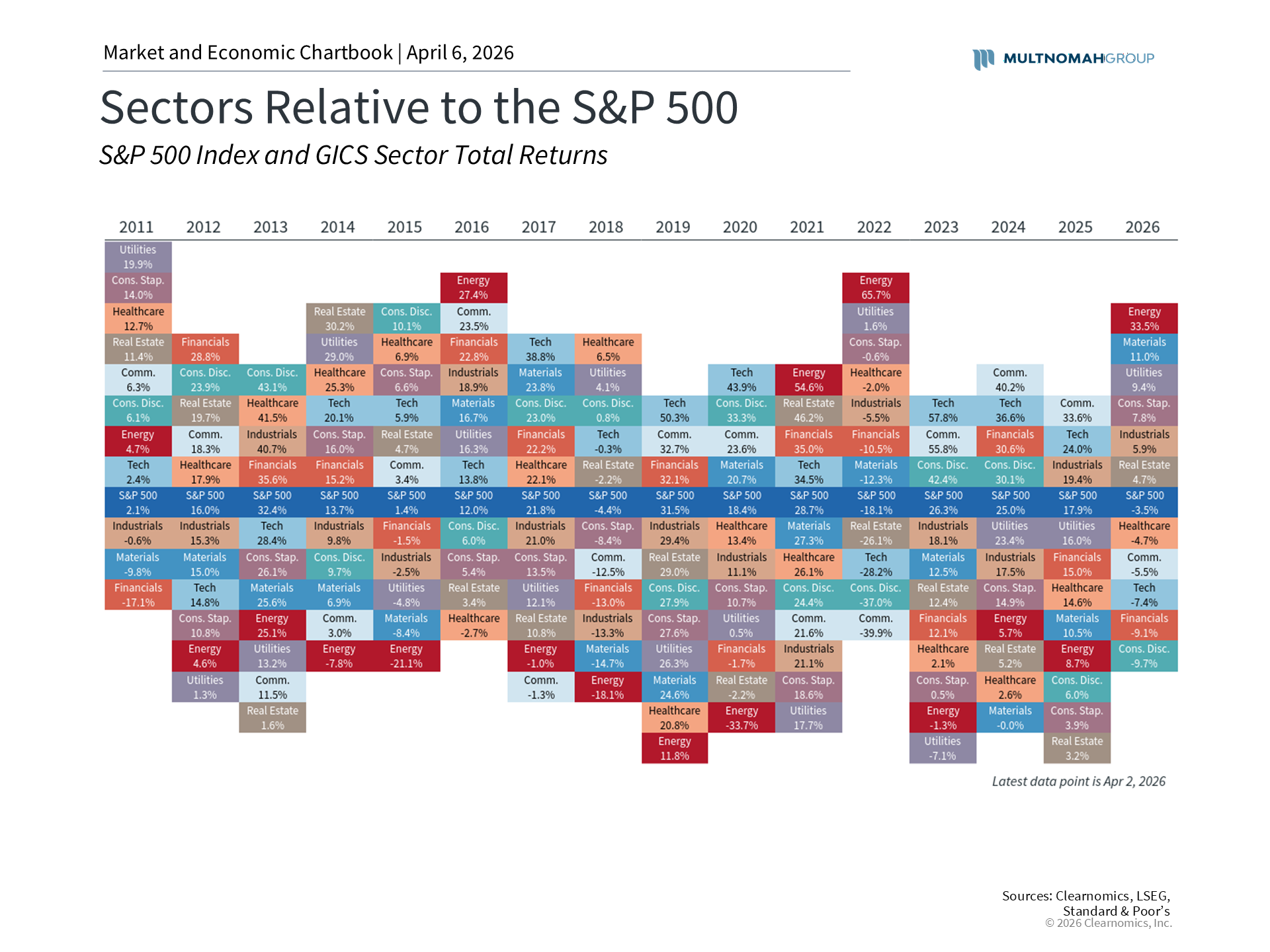
Even as the overall S&P 500 has pulled back, performance at the sector level has varied considerably. In fact, six of the eleven S&P 500 sectors are in positive territory year-to-date, and the gap between the best and worst performing sectors widened to nearly 50 percentage points during the first quarter.
The Energy sector has been the standout leader, gaining nearly 40% through the end of March, as higher oil prices are expected to boost revenues and drive further investment activity. Other areas of strength include Consumer Staples, Utilities, Materials, and Industrials, all of which have benefited from a more risk-conscious market environment. Many of these sectors are commonly viewed as “defensive,” as they represent businesses with relatively stable operations and more predictable cash flows that are less sensitive to the economic cycle.
By contrast, the Information Technology sector has declined approximately 9%, and a number of mega-cap stocks within the Magnificent 7 have underperformed. This marks a shift from recent years, when a handful of large technology companies accounted for the majority of market gains.
As always, it is important to keep these moves in perspective. As the chart above illustrates, sector leadership is cyclical and shifts with market and economic conditions. Energy was the top-performing sector in both 2021 and 2022, while technology-related stocks struggled during those same years — a dynamic that then reversed over the following three years. As with asset classes broadly, predicting which sector will lead or lag in any given year is extremely difficult, which is why a well-diversified portfolio is better positioned to withstand varying market environments.
The tariff story is evolving
Trade policy took a notable turn at the end of January after the Supreme Court ruled 6-3 that the broad tariffs imposed under the International Emergency Economic Powers Act (IEEPA) were unlawful. The administration responded by implementing a temporary global import duty under an alternative legal framework, Section 122 of the Trade Act of 1974. The administration also launched new Section 301 trade investigations in March, while approximately a dozen Section 232 investigations remain ongoing.
For investors, the primary takeaway is that while the legal foundation for tariffs has shifted, the broader direction of trade policy is likely to continue. Tariffs will probably continue to influence the economy through consumer prices, business costs, and investor sentiment. That said, last year demonstrated that markets are capable of adapting to these kinds of policy changes over time. Whatever direction the tariff story takes in the months ahead, the key principle remains the same: stay invested and avoid overreacting to policy developments.
The bottom line? The first quarter of 2026 challenges investors with geopolitical shocks, higher oil prices, and economic uncertainty. Yet markets have been resilient, with well-balanced portfolios and financial plans doing what they were designed to do. Investors should continue to focus on long run goals in the coming months.
Multnomah Group is a registered investment adviser, registered with the Securities and Exchange Commission. Any information contained herein or on Multnomah Group's website is provided for education purposes only and does not intend to make an offer or solicitation for the sale or purchase of any specific securities, investments, or investment strategies. Investments involve risk and, unless otherwise stated, are not guaranteed. Multnomah Group does not provide legal or tax advice.
Copyright (c) 2026 Clearnomics, Inc. All rights reserved. The information contained herein has been obtained from sources believed to be reliable, but is not necessarily complete and its accuracy cannot be guaranteed. No representation or warranty, express or implied, is made as to the fairness, accuracy, completeness, or correctness of the information and opinions contained herein. The views and the other information provided are subject to change without notice. All reports posted on or via www.clearnomics.com or any affiliated websites, applications, or services are issued without regard to the specific investment objectives, financial situation, or particular needs of any specific recipient and are not to be construed as a solicitation or an offer to buy or sell any securities or related financial instruments. Past performance is not necessarily a guide to future results. Company fundamentals and earnings may be mentioned occasionally, but should not be construed as a recommendation to buy, sell, or hold the company's stock. Predictions, forecasts, and estimates for any and all markets should not be construed as recommendations to buy, sell, or hold any security--including mutual funds, futures contracts, and exchange traded funds, or any similar instruments. The text, images, and other materials contained or displayed in this report are proprietary to Clearnomics, Inc. and constitute valuable intellectual property. All unauthorized reproduction or other use of material from Clearnomics, Inc. shall be deemed willful infringement(s) of this copyright and other proprietary and intellectual property rights, including but not limited to, rights of privacy. Clearnomics, Inc. expressly reserves all rights in connection with its intellectual property, including without limitation the right to block the transfer of its products and services and/or to track usage thereof, through electronic tracking technology, and all other lawful means, now known or hereafter devised. Clearnomics, Inc. reserves the right, without further notice, to pursue to the fullest extent allowed by the law any and all criminal and civil remedies for the violation of its rights.