

The Economy
The U.S. economy continued to expand during the third quarter of 2026, although signs of moderation became more apparent. Real gross domestic product grew at an annualized rate of 2.2% during the second quarter, slightly below the 2.5% pace recorded in the first quarter of the year. Consumer spending remained a key driver of growth, supported by wage gains and a still-healthy labor market, while business investment and exports also contributed positively. Higher imports, however, reduced the overall GDP calculation. Third-quarter GDP results will be released later in October and will provide additional insight into whether economic activity continued to cool as the year progressed.
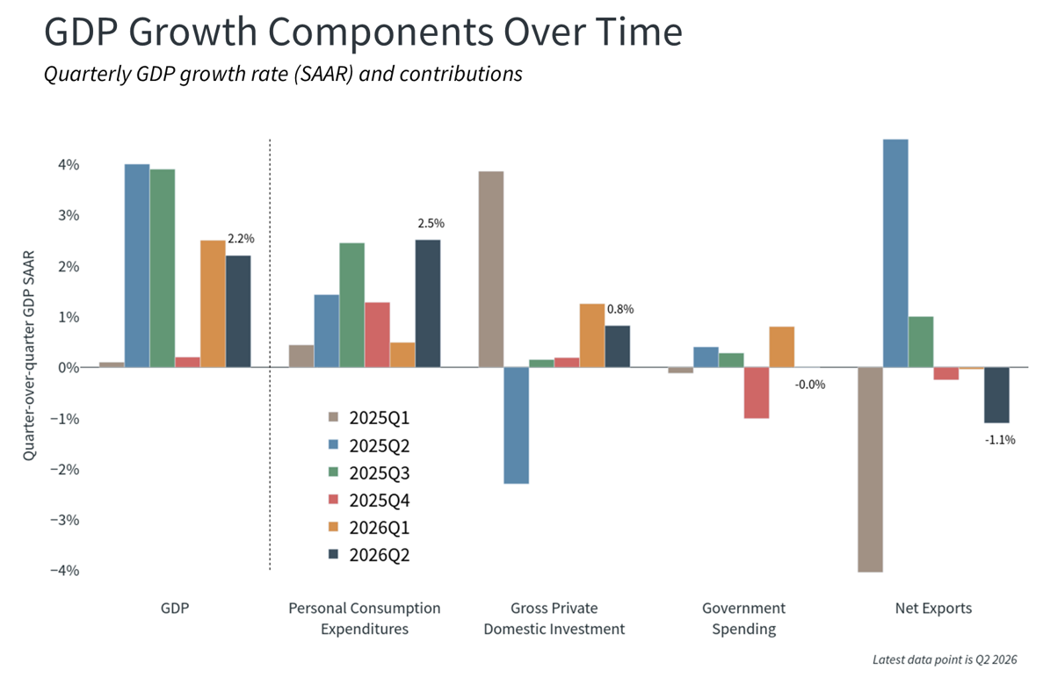
Labor market conditions remained stable but continued to show a gradual slowdown. Nonfarm payrolls increased by 29,000 in September, while the unemployment rate stood at 4.2%. Wage growth moderated to 3.0% over the prior twelve months, suggesting that labor market pressures have eased compared to the post-pandemic period. Although hiring has slowed, employment levels remain relatively healthy by historical standards and continue to support consumer spending, which remains the largest component of U.S. economic activity.
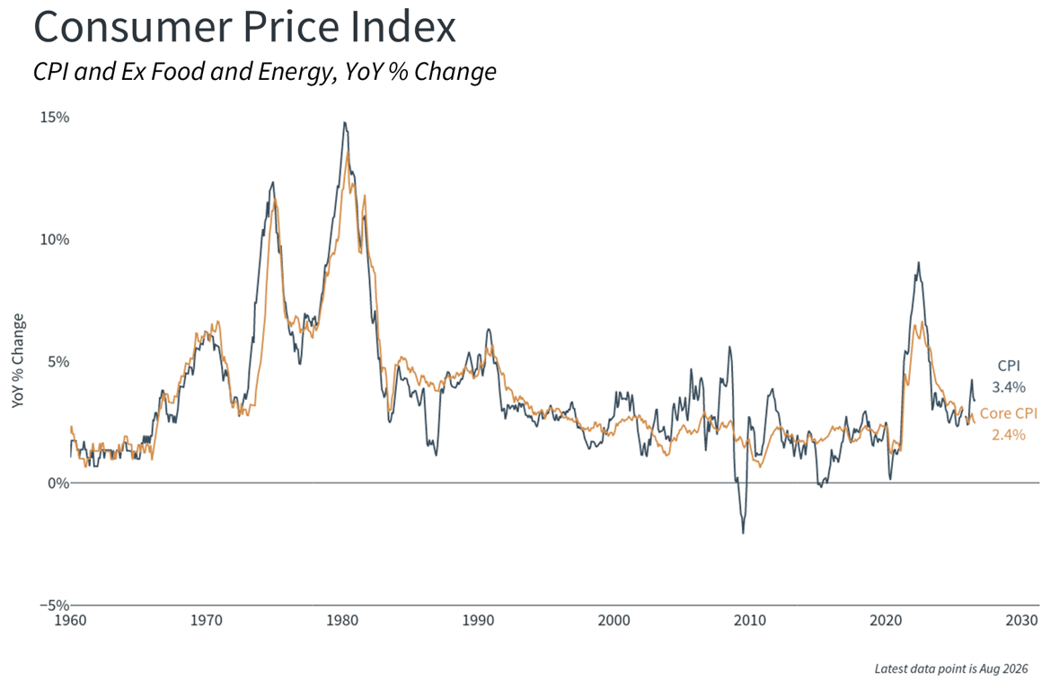
Consumer sentiment weakened during the quarter. The University of Michigan Consumer Sentiment Index declined 12.7% from a year earlier, reflecting continued concerns about inflation, borrowing costs, and household affordability. Inflation also remained above the Federal Reserve's long-term target. Through August, headline Consumer Price Index (CPI) inflation increased 3.4% over the prior year, while Core CPI, which excludes food and energy prices, rose 2.4%. Although inflation has moderated from peak levels experienced in recent years, policymakers continue to face the challenge of balancing inflation control with a labor market that is no longer expanding as rapidly as it once did.
Taken together, economic data suggest an economy that continues to grow but is entering a more mature phase of the expansion cycle. Growth remains positive, consumers are still spending, and unemployment remains relatively low; however, slower hiring, softer sentiment, and persistent inflation have created a more complex backdrop for investors and policymakers alike.
Fixed Income Markets
Interest rates returned to center stage during the third quarter. After holding policy rates steady since December 2025, the Federal Reserve raised the federal funds target range by 0.25 percentage points at its September meeting, bringing the range to 3.75% to 4.00%. The move reflected policymakers' continued focus on inflation, even as labor market growth slowed.
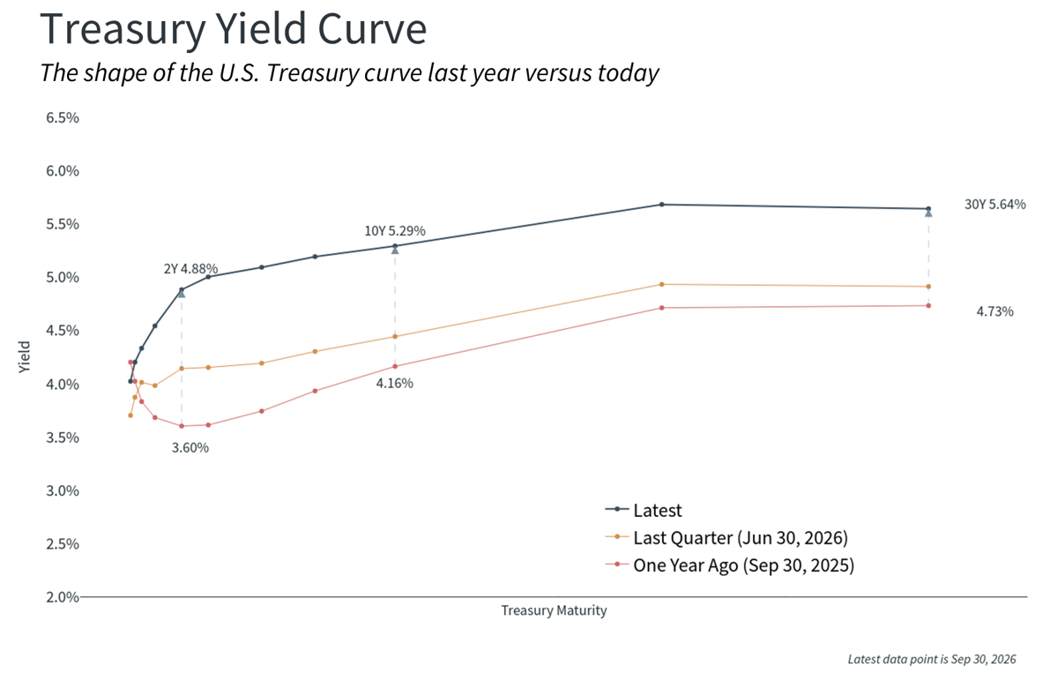
The rate increase, coupled with persistent higher inflation, large federal budget deficits, and high overall levels of U.S. government debt, contributed to a sharp rise in Treasury yields across the yield curve. By quarter-end, the 2-year Treasury yielded 4.88%, the 10-year Treasury yielded 5.29%, and the 30-year Treasury reached 5.64%. These yield levels were among the highest seen in recent years and represented a significant adjustment from levels observed earlier in 2026. Higher yields improved future income opportunities for bond investors but also led to meaningful price declines for many existing fixed-income securities.
As a result, fixed-income returns were broadly negative during the quarter. The Bloomberg U.S. Aggregate Bond Index declined 3.5%, while most sectors posted losses. Longer-duration segments were particularly affected because bond prices tend to be more sensitive to interest rate changes as maturities lengthen. Long Government/Credit bonds fell 7.7%, Mortgage-Backed Securities declined 4.3%, Investment Grade Corporate Bonds lost 3.9%, and Emerging Markets Debt fell 3.5%. By contrast, three-month Treasury bills gained 1.0%, benefiting from rising short-term interest rates and their limited interest-rate sensitivity.
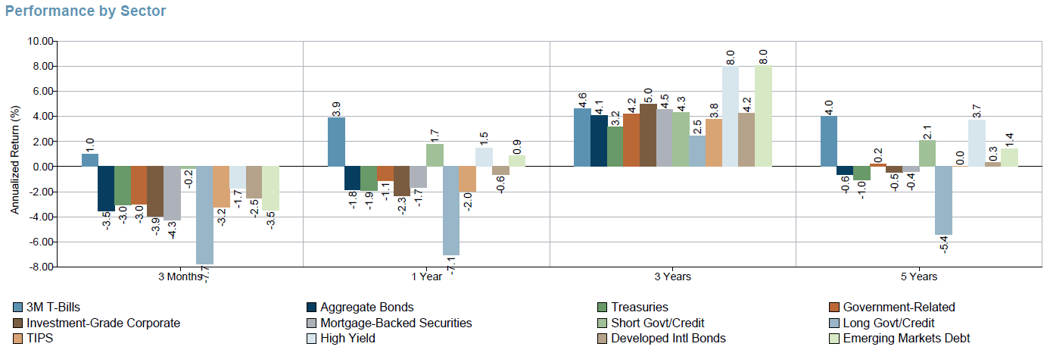
Returns by Sector: 3M T-Bills - USTREAS T-Bill Auction Ave 3 Mon; Aggregate Bonds - Bloomberg US Agg Bond TR USD; Treasuries - Bloomberg US Treasury TR USD; Government-Related - Bloomberg US Agg Govt Reltd TR USD; Investment-Grade Corporate – Bloomberg US Corp Bond TR USD; Mortgage-Backed Securities - Bloomberg US MBS TR USD; Short Govt/Credit - Bloomberg US Govt/Credit 1-3 Yr TR USD; Long Govt/Credit - Bloomberg US Govt/Credit Long TR USD; TIPS - Bloomberg US Treasury US TIPS TR USD; High Yield - Bloomberg US HY Interm TR USD; Developed Intl Bonds - Bloomberg Global Aggregate TR Hdg USD; Emrg Mkts Debt - Bloomberg EM USD Aggregate TR USD Equity Markets
The quarter serves as a reminder that bond returns can be challenged when interest rates rise rapidly, even in the presence of relatively healthy economic growth. For retirement plan participants, however, the increase in yields may improve the long-term outlook for fixed-income portfolios by providing higher income and the potential for stronger future returns than were available when interest rates were near historic lows.
Equity Markets
Despite considerable volatility, U.S. equity markets finished the quarter in positive territory. The S&P 500® Index returned 2.3%, extending its impressive one-year gain to 15.7%. Beneath the surface, however, market leadership remained narrow, and sector performance varied significantly.
Energy was the quarter's strongest-performing sector, gaining 17.2%, aided by rising oil prices and improving earnings expectations. Information Technology also performed well, returning 7.2%, as investors continued to reward companies benefiting from artificial intelligence-related spending and strong earnings growth in large-cap stocks. Health Care posted a solid gain of 6.5%, while Communication Services returned 3.6%. At the other end of the spectrum, Utilities declined 12.4%, Industrials lost 9.7%, and Real Estate fell 5.6%.
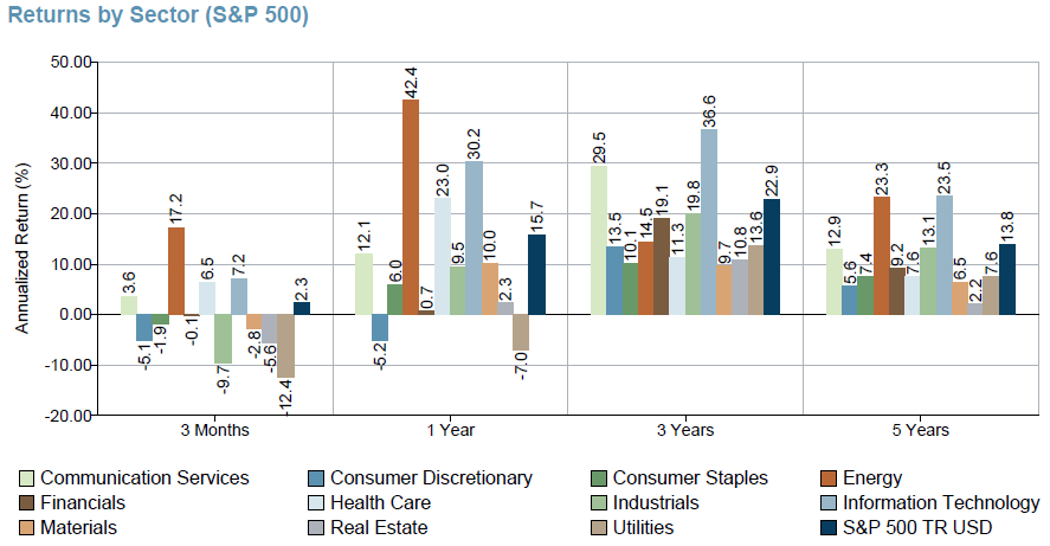
Returns by Sector are represented by the S&P 500 Index sector total return indices
Style and capitalization results reflected a preference for larger-company stocks. Large Value led major equity categories with a 2.6% gain, followed by Large Blend at 1.8%. Smaller-company equities struggled as higher interest rates pressured valuations and increased financing costs. Small Growth declined 9.4%, Small Blend fell 7.2%, and Small Value lost 4.9%. Mid-cap stocks also produced negative results across growth, blend, and value styles.
International markets generally trailed U.S. equities for the quarter. Developed international stocks gained 1.0%, while emerging markets declined 0.2%. Regional results were mixed. Japan and the broader Pacific region led performance with gains of 6.1% and 5.6%, respectively. Conversely, Europe ex-U.K. declined 2.6%, and Emerging Markets Asia fell 1.0%. Despite weaker quarterly results, emerging-market equities remained strong over longer periods, returning nearly 30% during the trailing one-year period.
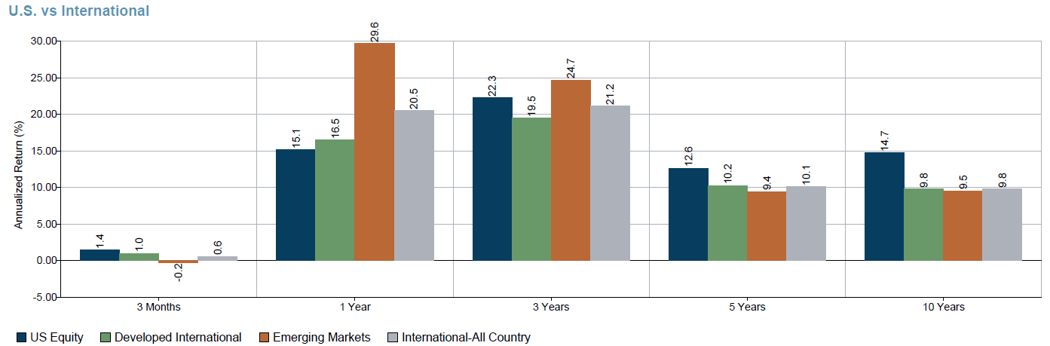
Returns by Market are represented by US Equity - Russell 3000 TR USD; Developed International - MSCI World Ex USA GR USD; Emerging Markets - MSCI EM GR USD; International-All Country - MSCI ACWI Ex USA GR USD
Outlook
Investors enter the fourth quarter facing several important questions. Foremost among them is the future path of monetary policy. The Federal Reserve's September rate increase demonstrated its ongoing commitment to controlling inflation, but policymakers must also consider slowing employment growth and the potential impact of higher borrowing costs on economic activity. As a result, market expectations surrounding future Fed decisions are likely to remain an important driver of both stock and bond market performance.
Artificial intelligence also remains a significant investment theme, although the market narrative continues to evolve. Earlier stages of the AI cycle rewarded companies supplying semiconductors, data centers, and computing infrastructure. During the third quarter, however, investors began demanding evidence that substantial AI-related spending can produce meaningful productivity gains and financial returns. As a result, performance leadership within AI-related companies became more selective, suggesting investors are moving beyond enthusiasm alone and increasingly focusing on measurable business outcomes.
Another area to watch is market leadership. For much of the past several years, returns have been concentrated among a relatively small group of large-cap growth companies. The third quarter's stronger performance from Large Value stocks and widening dispersion among technology companies may indicate that investors are beginning to search for opportunities beyond the market's traditional leaders. Whether this develops into broader market participation or proves temporary will likely be an important theme for investors in the coming quarters.
Multnomah Group is a registered investment adviser registered with the Securities and Exchange Commission. Any information contained herein or on Multnomah Group’s website is provided for educational purposes only and does not intend to make an offer or solicitation for the sale or purchase of any specific securities, investments, or investment strategies. Investments involve risk and, unless otherwise stated, are not guaranteed. Multnomah Group does not provide legal or tax advice.