

Quarterly Market Commentary
Caryn Sanchez walks through our quarterly market commentary for the fourth quarter of 2025.
You can listen to it here:
Her full coverage is below.
The Economy
The fourth quarter was shaped by a historic 43‑day federal government shutdown (Oct. 1–Nov. 12, 2025), which created a broad blackout in official U.S. economic data and temporarily halted normal operations across key statistical agencies. During this period, the Bureau of Labor Statistics paused most releases—with the exception of the previously collected September CPI—while the Bureau of Economic Analysis delayed national‑accounts reporting, leaving October as a lasting blind spot for several key datasets.1
The Congressional Budget Office estimated the shutdown shaved 1.0–2.0 percentage points (annualized) from fourth‑quarter real GDP growth, with $7–$14 billion in output likely not recovered, further complicating the Federal Reserve’s real‑time policy assessment and market visibility.1
Prior to the shutdown, the U.S. economy maintained momentum heading into autumn. GDP rose at an annualized pace of 4.3% in the third quarter of 2025, up from 3.8% in the second quarter, supported by broad consumer spending, exports, and government outlays, while a decline in investment provided a partial offset. Overall, the composition of growth points to continued resilience in household demand and steady contributions from the public sector, even as business investment softened.

Labor conditions cooled but remained orderly by year‑end. Nonfarm payrolls increased by 50,000 in December 2025, and the unemployment rate held at 4.4%. Average hourly earnings rose 0.3% month‑over‑month and 3.8% year‑over‑year, indicating moderating but still positive wage growth.2
The demand for workers continued to rebalance: JOLTS reported 7.1 million job openings as of November 2025 (down about 885,000 over 12 months), with hires and total separations each near 5.1 million and the rate of employees quitting edging up to 2.0%—a pattern consistent with a “low‑hire, low‑fire” environment. The openings‑to‑unemployed ratio moved to roughly 0.9, the lowest since early 2021, signaling progress toward better alignment between labor demand and supply without a marked rise in layoffs.3
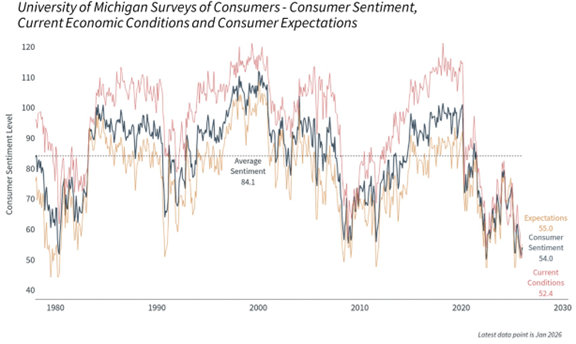
Consumer views improved modestly to start 2026. The University of Michigan’s Index of Consumer Sentiment rose to 54.0 in the preliminary January reading (up from 52.9 in December), its highest level since September 2025. The gain was concentrated among lower‑income households, while sentiment slipped for higher‑income consumers. Despite the uptick, overall sentiment remains nearly 25% below January 2025 levels, reflecting ongoing sensitivity to “kitchen‑table” issues such as prices and a cooler job market. One‑year inflation expectations held at 4.2%, while long‑run expectations edged up to 3.4%.4
Through December 2025, headline CPI increased 2.7% year‑over‑year, with Core CPI up 2.6%. On a monthly basis, headline CPI rose 0.3% and Core CPI 0.2%, led by a 0.4% gain in shelter and a 0.7% increase in food prices.5
For the PCE price indexes, the latest published BEA estimates (pre‑shutdown) showed headline PCE up 2.8% year‑over‑year in September and core PCE up 2.8%. To address the data gap, BEA rescheduled October–November 2025 Personal Income and Outlays to Jan. 22, 2026, with December 2025 PCE slated for Feb. 20, 2026.6
Fixed Income Markets
The Federal Reserve cut rates three times in 2025—September, October, and December—citing softer labor‑market conditions and inflation that, while easing, remained above target. The final move brought the federal funds target range to 3.5%–3.75% as of Dec. 10, 2025.
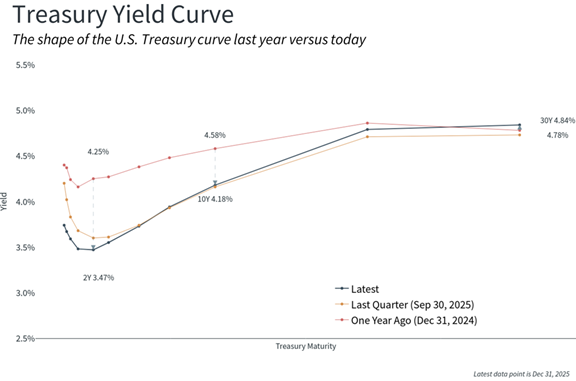
As of Dec. 31, 2025, the 2‑year Treasury yield was at 3.48% and the 10‑year at 4.16%, both lower than at Dec. 31, 2024 (roughly 4.24% and 4.57%, respectively). The decline reflects the Fed’s shift toward easing monetary policy and gradually cooler inflation. Compared with the prior year, the curve’s shape looked healthier, with short‑term rates falling more than long‑term rates—an adjustment that supported bond returns and broader market sentiment heading into 2026.8
Most fixed income sectors delivered positive results for the quarter, helped by falling rates and an improving inflation backdrop. Emerging Markets Debt led with a 3.0% gain, followed by Mortgage‑Backed Securities at 1.7%. Developed International Bonds were the only major segment in negative territory, down 2.0%. Overall, the late‑2025 interest‑rate environment steadied returns across many parts of the bond market.
Equity Markets
The S&P 500® rose 2.7% in the fourth quarter and finished 2025 up 17.9%, reflecting a broadly supportive environment despite periods of uncertainty. Leadership throughout the year varied: Health Care gained 11.7% in the quarter, and Communication Services advanced 7.3%, while more rate‑sensitive areas like Real Estate and Utilities declined 2.9% and 1.4%, respectively. Taken together, the quarter underscored how sectors tied to growth and innovation fared better than those more sensitive to changes in interest rates.
For the 12‑month period, Communication Services led with a 33.6% return, reflecting strong results among media and technology‑enabled firms, while Technology rose 24%. More defensive areas, such as Real Estate and Consumer Staples posted modest gains (3.2% and 3.9%, respectively) as higher‑rate sensitivity and slower growth profiles weighed on results. Overall, sectors connected to digital services and innovation outperformed, while more rate‑dependent or slower‑growing segments lagged.
Performance across size and style differed meaningfully in 2025. Large Value stocks posted the strongest Q4 gains at 3.8%, supported by steadier earnings and lower interest‑rate sensitivity. Mid‑Cap Growth was the only segment with a negative quarter (down 3.7%), as investors favored firms with less reliance on distant‑future growth. Over the full year, Large Growth led with an 18.6% return, while Mid‑Cap Growth again trailed, rising 8.7%. The pattern suggests investors gravitated toward larger, established businesses, especially those with technology and innovation exposure, amid shifting rate expectations and uneven data.
Outside the U.S., results were strong. In the fourth quarter, Developed International Markets rose 5.3% and Emerging Markets gained 4.8%, both outpacing the U.S. equity market’s 2.4% return. Regionally, Latin America led with 8.4%, followed by the U.K. at 7.0%, while the Pacific region increased 2.2%. Over the one‑year period, Emerging Markets and Developed International Markets climbed 34.4% and 32.5%, respectively. International and emerging market outperformance highlights how improving global growth prospects, stabilizing inflation, and supportive monetary policies abroad benefited international shares. For many investors, the year underscored the value of diversification.
Outlook
The past year illustrated the Fed’s challenge: inflation eased but remained above its 2% target, while the job market cooled. Entering 2026, the environment is still mixed, and the pace of any further policy adjustment will depend on incoming data. The Fed’s projections and several market strategists anticipate limited additional easing this year, with debate over timing and magnitude given the balance of risks.9
November’s government spending bill runs out at the end of January; new budget negotiations could create market uncertainties.
Investors continue to watch whether U.S. equity leadership broadens beyond a handful of large technology‑oriented names. The key question for 2026 is whether AI‑related momentum persists or new themes emerge as economic conditions evolve.
Footnotes
1 Government shutdown and data blackout (impact on BLS/BEA releases; potential GDP effects; market/policy implications). https://www.bls.gov/cpi/notices/2025/2025-federal-government-shutdown-impact-on-cpi.htm
2 Employment Situation—December 2025 (payrolls, unemployment rate, wages). https://www.bls.gov/news.release/archives/empsit_01092026.htm
3 JOLTS—November 2025 (openings, hires, separations, quits; openings‑to‑unemployed ratio). https://www.bls.gov/opub/ted/2026/7-1-million-job-openings-in-november-2025.htm
4 University of Michigan Surveys of Consumers—January 2026 (preliminary) (headline, components, inflation expectations). https://www.sca.isr.umich.edu/
5 CPI—December 2025 (headline/core y/y; monthly details: shelter, food). https://www.bls.gov/news.release/archives/cpi_01132026.htm
6 PCE schedule (post‑shutdown) (timing for Oct–Nov and Dec 2025 releases). https://www.bea.gov/news/blog/2026-01-07/economic-release-schedule-updates-gdp-personal-income-and-outlays
7 Fed rate cuts and policy stance—2025 (three cuts; 3.5%–3.75% range as of Dec. 10). https://www.cnbc.com/2025/12/10/fed-interest-rate-decision-december-2025-.html
8 Treasury yields and curve—year‑end comparison (2‑year, 10‑year; 2025 vs. 2024). https://www.cnbc.com/2025/12/31/10-year-treasury-yield-in-focus-as-investors-monitor-economic-data.html
9 Policy outlook—limited additional easing (2026 projections/strategist views). https://www.congress.gov/crs_external_products/IN/PDF/IN12635/IN12635.1.pdf
References (APA)
Bureau of Labor Statistics. (2025, Dec. 17). Questions and answers on the 2025 federal government shutdown impact on the Consumer Price Index. https://www.bls.gov/cpi/notices/2025/2025-federal-government-shutdown-impact-on-cpi.htm
Friends of the Bureau of Labor Statistics. (2025, Nov. 12). 2025 government shutdown FAQs on BLS data. https://www.friendsofbls.org/updates/2025/11/12/2025-government-shutdown-faqs-on-bls-data
Congressional Budget Office. (2025, Oct. 29). A quantitative analysis of the effects of the government shutdown on the economy under three scenarios (Letter to Hon. Jodey Arrington). https://www.cbo.gov/system/files/2025-10/61823-Shutdown.pdf
J.P. Morgan. (2025, Nov. 19). US government shutdown: What’s the impact on the economy and markets? https://www.jpmorgan.com/insights/global-research/current-events/government-shutdown
Bureau of Labor Statistics. (2026, Jan. 9). The Employment Situation — December 2025 (USDL‑26‑0020). https://www.bls.gov/news.release/archives/empsit_01092026.htm
Bureau of Labor Statistics. (2026, Jan. 13). 7.1 million job openings in November 2025. https://www.bls.gov/opub/ted/2026/7-1-million-job-openings-in-november-2025.htm
University of Michigan, Surveys of Consumers. (2026, Jan. 9). Preliminary results for January 2026. https://www.sca.isr.umich.edu/
American Bankers Association. (2026, Jan. 9). Preliminary: Consumer sentiment increased 1.1 points in January. ABA Banking Journal. https://bankingjournal.aba.com/2026/01/preliminary-consumer-sentiment-increased-2-3-points-in-january/
Bureau of Labor Statistics. (2026, Jan. 13). Consumer Price Index — December 2025. https://www.bls.gov/news.release/archives/cpi_01132026.htm
Bureau of Economic Analysis. (2026, Jan. 7). Economic release schedule updates: GDP, Personal Income and Outlays. https://www.bea.gov/news/blog/2026-01-07/economic-release-schedule-updates-gdp-personal-income-and-outlays
CNBC. (2025, Dec. 10). Fed approves third rate cut this year, sees slower pace ahead. https://www.cnbc.com/2025/12/10/fed-interest-rate-decision-december-2025-.html
Congressional Research Service. (2025, Dec. 22). Federal Reserve cuts interest rates in late 2025 (INSIGHTi). https://www.congress.gov/crs_external_products/IN/PDF/IN12635/IN12635.1.pdf
UBS. (2026, Jan. 12). What do Fed rate cuts mean for investors? https://www.ubs.com/us/en/wealth-management/insights/market-news/article.2979043.html
CNBC. (2025, Dec. 31). 10‑year Treasury yield closes out 2025 lower for year. https://www.cnbc.com/2025/12/31/10-year-treasury-yield-in-focus-as-investors-monitor-economic-data.html
CNBC. (2024, Dec. 31). 10‑year U.S. Treasury yield climbs on last trading day of 2024. https://www.cnbc.com/2024/12/31/us-treasurys-last-trading-day-of-2024.html
YCharts. (n.d.). 5‑Year Treasury rate—historical yield trends (shows 3.73% on Dec. 31, 2025). https://ycharts.com/indicators/5_year_treasury_rate
Multnomah Group is a registered investment adviser registered with the Securities and Exchange Commission. Any information contained herein or on Multnomah Group’s website is provided for educational purposes only and does not intend to make an offer or solicitation for the sale or purchase of any specific securities, investments, or investment strategies. Investments involve risk and, unless otherwise stated, are not guaranteed. Multnomah Group does not provide legal or tax advice.